
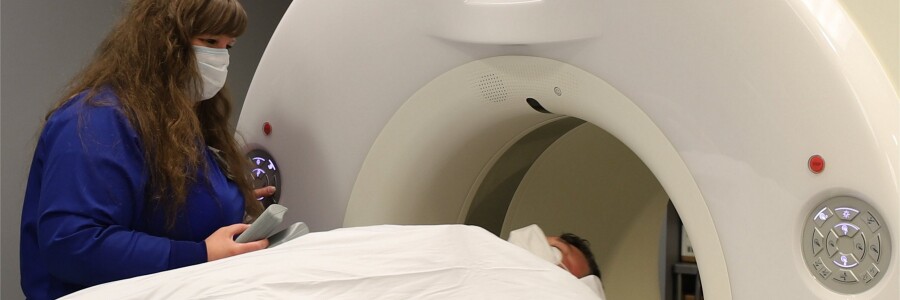
Radiologic technologists are trained in the use of different types of medical diagnostic equipment. They may choose to specialize, such as in x-ray, mammography, or computed tomography (CT) imaging.
Computed Tomography (CT) is an x-ray imaging technique that uses a computer to produce sectional images of the body to show anatomy and pathology at different levels.
Computed technology (CT) scans are ordered on trauma, cancer, and non-trauma patients and are often the first diagnostic imaging exam ordered on patients. A computed technologist works in hospitals or outpatient healthcare facilities using a CT scanner with an x-ray unit that rotates to image anatomy in the body as slices. The images are assembled and reconstructed digitally to create a series of diagnostic images that physicians use to interpret for a patient diagnosis.
The U.S. Bureau of Labor Statistics projects the overall employment of radiologic and MRI technologists to grow by 7% from 2019 to 2029, faster than the average for all occupations.1 As the population grows older, there will be an increase in medical conditions that require imaging as a diagnostic tool.
NEW PROGRAM! Enroll today in the Online Computed Tomography Undergraduate Certificate at Kent State University
The Online Computed Tomography undergraduate certificate provides coursework in anatomy, patient management, procedures, and image production. Students observe computed tomography procedures, perform procedures under the direct supervision of registered technologists and complete required clinical competencies toward the national certification exam for computed tomography or to be applied toward continuing education requirements as deemed by the American Registry of Radiologic Technologists (ARRT).
The Online Computed Technology undergraduate certificate offers a seamless transfer pathway into the Bachelor of Radiologic Imaging Sciences Technology (B.R.I.T.) degree. Students are able to complete the certificate, sit for the national certification exam, begin working in the profession and then enroll in the B.R.I.T. degree and complete the remaining requirements to earn the bachelor’s degree. The BRIT degree requires a grade of “C” (2.0) or better in the required RIS courses and a minimum of 2.75 cumulative GPA in the major.
Graduates of this online Computed Tomography undergraduate certificate program will be able to:
- Apply knowledge to the practice of computed tomography.
- Effectively utilize critical thinking, problem-solving, and decision-making skills in the practice of computed tomography.
- Effectively communicate in oral and written form with patients, customers, and all members of the health care team.
- Successfully perform computed tomography procedures and attain results of high diagnostic value, while providing patient care.
- Exhibit personal and professional attributes and values relevant to the practice of computed tomography.
This program is designed to be completed in as little as 30 weeks.
For more information on Kent State’s Online Computed Tomography Undergraduate Certificate, visit https://onlinedegrees.kent.edu/degrees/certificate-computed-tomography.
Sources:
1 Retrieved on June 22, 2021, from https://www.bls.gov/ooh/healthcare/radiologic-technologists.htm


